If you've been an athletic director for more than a few seasons, you've seen it happen more times than you'd like to admit. Mid-play. An athlete's foot catches on an untied lace. An ankle rolls. The season cracks.
You know it's coming. That's the part nobody talks about enough.
The question isn't whether it'll happen again. It's whether you're still accepting a risk you now have the option to eliminate entirely.
The Hidden Cost Nobody Talks About
Before an athlete ever trips, the lace problem is already extracting a cost from your program. It's hidden in time — and time is the one resource every athletic department is short on.
Pre-game equipment checks: Double-knotting is a ritual in most programs. Some coaches build 10 minutes into pre-game warmups just for lace checks. Multiply that across a 100-athlete roster and you're looking at hours of staff time every week — for a problem that shouldn't exist.
Halftime adjustments: Athletic trainers and coaches spend halftime managing equipment. Lace adjustments are a recurring line item. That's time not spent on injury prevention briefings, tactical adjustments, or athlete recovery conversations.
Practice transitions: In multi-sport or multi-configuration environments, athletes switching shoes repeatedly face the same lace problem at scale. Every minute spent retying is a minute not spent training.
Mid-play timeouts: When a lace comes undone during a drill or practice scrimmage, someone has to stop the session. When it happens mid-game, the timeout is mandatory and the momentum cost is real.
Athletic directors who have run the math on this describe it as a recurring tax on their program — small individually, large in aggregate, and completely unnecessary.
The Liability Question
Here's the part that should get every AD's attention: lace-related trip injuries are predictable.
Predictable injuries are expensive injuries. That's the logic insurance carriers and legal teams work from. An athlete trips on a known equipment hazard — one documented in sports medicine literature, one that programs build workarounds around, one that every coach in the building has seen coming at least once — and that predictability is what makes the claims expensive.
The numbers back it up. Across U.S. high school sports, lace-related preventable injuries cost an estimated $19 billion annually. ACL reconstructions run $20,000–$50,000 per athlete when you include surgery, rehab, and lost athletic value. Concussions from falls cost more in recovery time and long-term health risk. And none of these are contact injuries — they're equipment failures.
When these injuries occur on your watch, the first question from any legal review is: what did you know, and when did you know it? Athletic directors who've implemented documented safety upgrades — including equipment that specifically eliminates lace trip hazards — have a materially different answer to that question than those who haven't.
Why D1 Programs Are Already Moving
The shift is happening at the top of the pyramid first. Division 1 football programs, where the stakes of injury are highest and the equipment budgets are most sophisticated, have been quietly evaluating and adopting no-tie lace systems over the past two seasons.
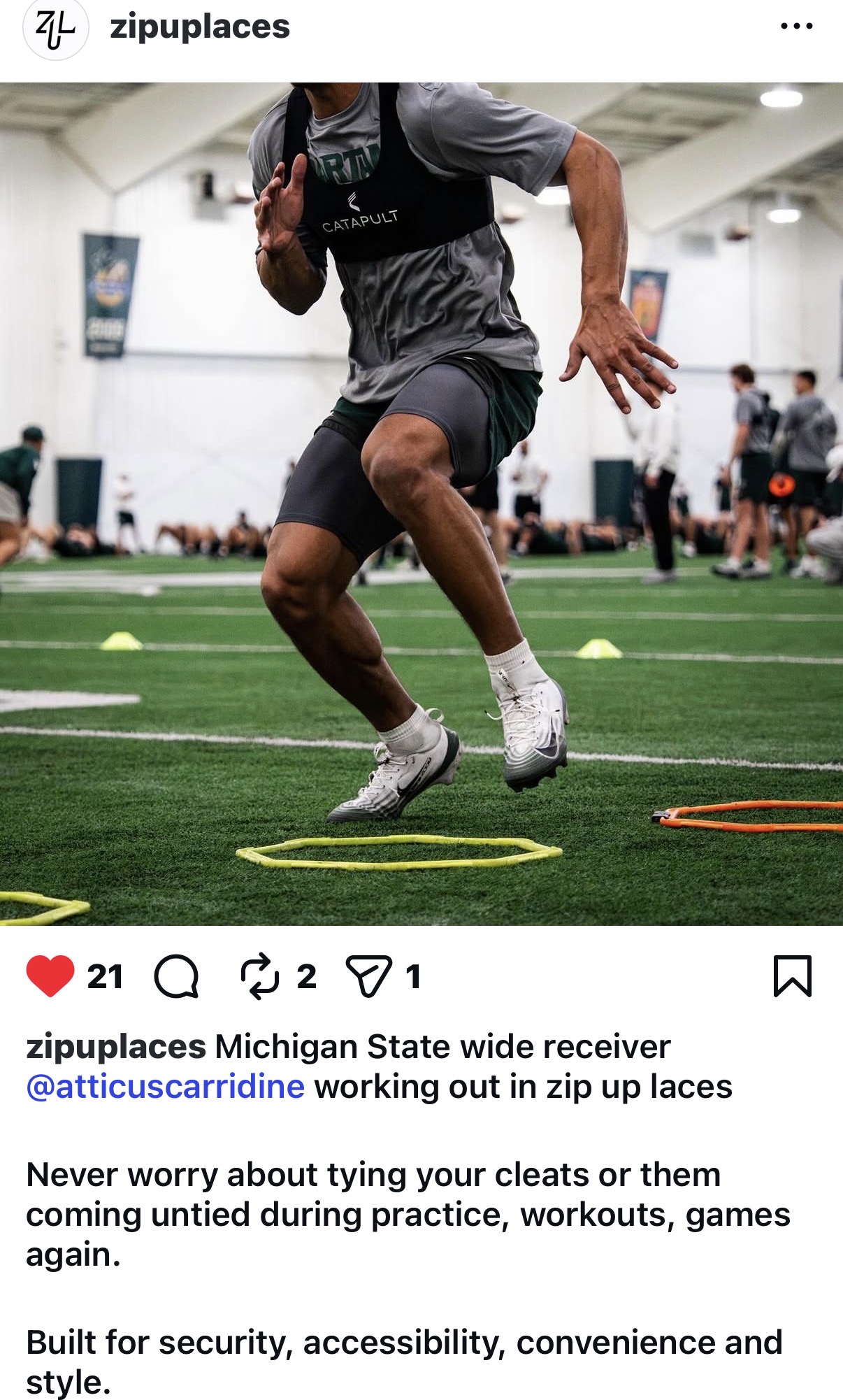
One documented case: a Michigan State wide receiver wore Zipuplaces in a cleat-change drill without the coaching staff knowing. Catapult performance trackers were visible in game footage. He won the drill, outperforming teammates in the same exact conditions.
"They don't just change the game, they change the preparation before, during, and after play." — Michigan State WR, D1 athlete
D1 programs don't adopt equipment casually. The approval path for a significant change in athlete equipment is rigorous — it goes through strength and conditioning staff, athletic trainers, equipment managers, and coaching staff. When those programs move, it's because the evidence is there.
What's changing the calculation at the D1 level is simple: the liability question has gotten more expensive, the performance question has gotten a real answer, and the cost of switching has dropped to near zero with free sample programs from manufacturers.
What to Look For in a No-Tie Lace System
Not all no-tie systems are the same. If you're evaluating a switch, here are the criteria that actually matter for an athletic program:
- Durability under athletic use: Athletic shoes take real punishment — lateral cutting, high-impact landings, repeated flex cycles. The closure mechanism needs to hold up across a full season without degradation in tension or function.
- Consistent tension, every time: The goal isn't just "doesn't come untied" — it's that the shoe stays exactly as the athlete fitted it, without the micro-loosening that traditional laces experience through use.
- Water and dirt resistance: Traditional laces absorb both. In outdoor sports, that means changed feel, changed weight, and changed performance over the course of a game. A no-tie system that handles moisture and debris without degradation is meaningfully different from one that doesn't.
- Universal fit across sports and shoe types: If the system only works in one specific shoe configuration, it won't scale across your program. Look for something that works across football, soccer, lacrosse, baseball, and training footwear.
- Showable on-field: Some no-tie systems protrude from the shoe in ways that are not permissible in competition. The Zipuplaces system is the only no-tie system that can be shown in cleats on the field — an important distinction for programs with strict equipment compliance requirements.
Download our athletic program evaluation checklist or request a free product sample to test across your sports. We follow up within 24–48 hours: /zipuplaces →
The Decision Point
The case for switching isn't complicated. You're already managing a problem that's been documented for 150 years. You've built workarounds around it. Your insurance premiums reflect it. Your athletic trainers watch for it. And now there's an engineered solution that's been validated at the Division 1 level.
The only question is timing.
Programs that switch now have a documented record of identifying a hazard and implementing a safety solution proactively — before a serious injury occurs. That record is defensible. Programs that wait until after an incident are in a fundamentally different position.
The shift is happening. The athletic directors making the move are doing it for one simple reason: the math finally works in favor of acting.
See what D1 programs are already using
Request a free Zipuplaces sample for your athletic program. We'll follow up within 24–48 hours.
Request Free Sample →Wholesale pricing available · Patent Pending · D1 validated