Your great-grandfather tied his shoes the same way you tie yours. And his great-grandfather did it the same way. In 150 years, while zippers revolutionized everything from jackets to backpacks to boots, one thing remained frozen in time: the athletic lace.
It's the most persistent design failure in sports.
The Invisible Injury Crisis
The numbers are quietly staggering. Across American high school sports alone, loose or untied laces contribute to an estimated $19 billion in preventable injuries annually—from ankle sprains to ACL tears to concussions from falls. In Major League Baseball, non-contact injuries linked to lace failures cost teams $1 billion every year in medical expenses, lost games, and rehabilitation.
These aren't hypotheticals. They're in every athletic department's budget. Every program has seen it: an athlete trips on their own laces mid-play. Foot catches slightly. Ankle rolls. Hamstring tears from the awkward landing. Concussion from hitting the turf wrong. Game over. Season potentially over.
And here's what makes it worse: athletic directors know it's coming. They watch for it. They tell athletes to double-knot. They call timeout mid-game for lace adjustments. They build equipment management time into practice schedules. Entire systems exist just to manage the fallout from a design that hasn't been meaningfully improved since your great-grandfather was a kid.
The Real Cost
Pick any college athletic program. Football spends more on injury prevention equipment and recovery than on most other operational expenses. Why? Because injuries are expensive. Alabama's football program spends $82 million annually. That's for one sport at one school. Now scale that across 40,000+ high schools and 1,200+ colleges nationwide. The invisible tax of loose laces is woven into every budget line.
Then there's the liability. Athletic departments carry insurance premiums that are calculated, in part, around preventable injuries. Lace-related trips get lawyers' attention. They're predictable. They're preventable. And when they happen, there's documentation.
Why This Problem Wasn't Solved
The answer is absurdly simple: nobody stopped to really look at it. Laces became such an accepted part of the system that fixing them never rose to the priority level it deserved. Engineers focused on cushioning, ankle support, materials—everything except the one thing holding the shoe on the foot.
It's like staring at a problem every single day and deciding it's just how things are.
Until someone decided it wasn't.
25 Years of Precision
Anton Jones has spent 25 years designing for the world's most demanding performers—rock musicians who need precision, durability, and complete reliability under extreme conditions. On stage, under hot lights, drenched in sweat and moving for two hours straight, equipment can't fail. It doesn't get a second take.
That precision mindset turned toward a simple question: What if a lace system simply couldn't come undone?
Not a new way to tie. Not a stronger knot. Not an incremental improvement.
What if you eliminated the problem entirely—engineered a closure mechanism so fundamentally different that the concept of "coming undone" didn't apply?
The result: Zipuplaces—the first lace system designed from scratch with one non-negotiable requirement: it cannot come undone.
How It Changes Everything
Zipuplaces replaces the traditional lace loop with a patent-pending closure mechanism. Install it once. You never retie it. The tension stays consistent—no loosening, no shifting, no mid-game adjustments. It's water-resistant and dirt-resistant (traditional laces absorb both). And critically: if a Zipuplaces shoe comes partially unzipped, you still cannot trip on it.
The trip hazard is gone.
But that's just the start.
Zero maintenance means no timeout for lace adjustments. No pre-game ritual of double-knotting. Rosters transition faster. Athletes focus on performance, not equipment management. Competitive programs reduce a recurring, predictable source of non-contact injuries.
The D1 Proof
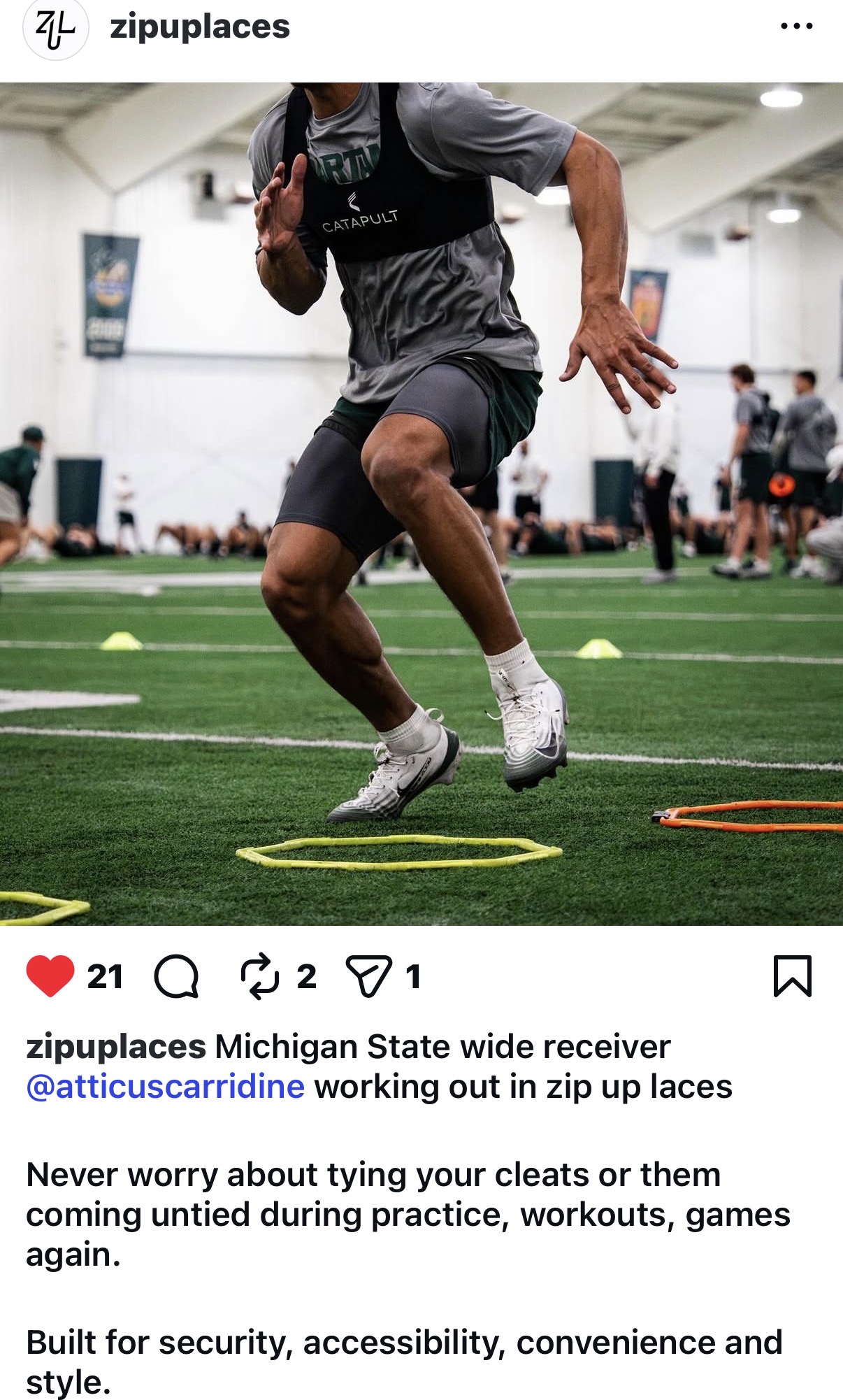
A Michigan State wide receiver wore Zipuplaces in a cleat-change drill last season—without the coaching staff even knowing. Catapult performance trackers visible in game footage. He won the drill, outperforming teammates in the same exact conditions.
"They don't just change the game, they change the preparation before, during, and after play." — Michigan State WR, D1 athlete
That's the insight athletic programs are looking for. It's not just a lace system. It's a compression of an entire equipment problem into one decision that ripples through preparation, performance, and recovery.
The Liability Angle
For athletic directors, there's a second layer of value here that doesn't appear in highlight reels.
Preventable injuries from loose laces are documented, recurring, and expensive. Switching to a system specifically engineered to eliminate that hazard? That's a documented risk mitigation strategy. Insurance companies notice that. Lawyers notice that. Parents notice that.
Programs that implement Zipuplaces across their rosters aren't just giving athletes a competitive edge. They're making a measurable commitment to injury prevention—one that shows up in next year's insurance premium discussions and injury liability conversations.
150 Years Is Long Enough
The most sophisticated equipment in modern sports surrounds the lace problem. Ankle braces. Ankle taping. Recovery protocols. Injury prevention training. All of it exists, in part, because the one thing holding the shoe on hasn't evolved.
It's a weird hill to see unsolved for this long.
Until now.
Zipuplaces isn't an incremental improvement to traditional laces. It's what happens when you ask the simple question everyone somehow missed: What if laces didn't come undone?
For athletic programs looking to eliminate a recurring injury source, reduce liability exposure, and give their athletes a competitive edge without adding complexity—there's finally an answer.
The game just changed.
Ready to eliminate the problem?
Request a free sample for your athletic program. We'll follow up within 24–48 hours.
Request Free Sample →Wholesale pricing available · Patent Pending · D1 validated